The right machine for your process
Torches, wide-web curtains, surface sources, automated cells, thin-film deposition and quality control. Every machine we supply treats at atmospheric pressure : no vacuum chamber, no solvent, and it drops straight onto your line.
Plasma equipment is chosen based on your actual production requirements: the part, throughput, and critical step.
Our nine machines are therefore sorted by the problem they solve: four families,
then a comparison table. The index below names all nine of them.
The catalogue on one screen
Four families, nine machines. Open the family that describes your problem, or go straight to the machine by name. The comparison table puts all nine side by side.
Adhesion failure (or loss of adhesion)
- Compact plasma torch
- Plasma curtain
- Surface-discharge plasma source
- Precision cold plasma torch
- DBD plasma reactor
Surface functionalization: barrier, anti-corrosion, scratch resistance
Deposit a coatingOr answer these three questions: the index above updates, and the cards below are filtered.
No catalogue configuration covers exactly this combination — and that is precisely what our engineering office does : the reactor is then sized around your material, your takt time and your production environment. Tell us about your part →
Activate and clean a surface
Nine adhesion problems out of ten are solved upstream, by raising surface energy right before the critical step. Plasma strips organic contamination and grafts chemical functions that make adhesives, inks and coatings hold. Which machine you need follows from the geometry of the part and the width to be treated.
Understand the adhesion mechanism →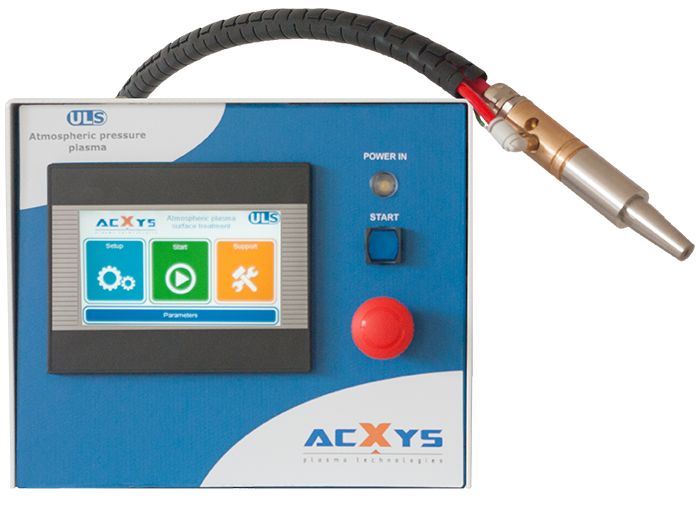
Compact plasma torch
A nozzle that blows plasma straight onto the area to be treated, a few millimetres from the part. Mounts on a robot arm or on a fixed in-line station. This is the most common way to treat a precise area without touching the rest of the part.
- Laboratory configuration — one nozzle, benchtop format, for R&D and short runs.
- Production configuration — one, two or three nozzles, for pilot line or production.
- Three nozzle geometries — straight, rotary, or straight at 45° depending on access to the area.
Technical specifications
Plasma curtain
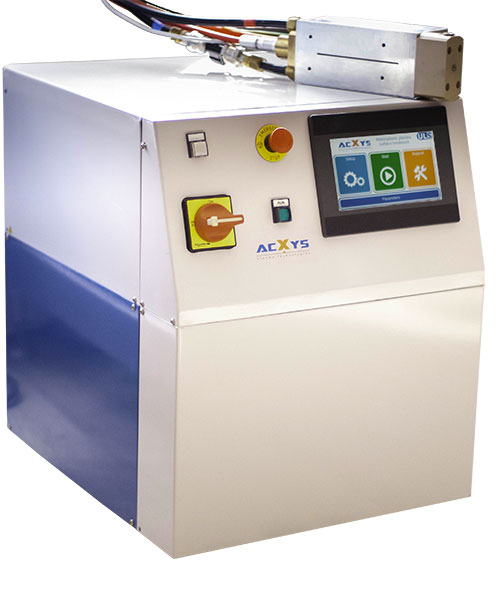
A source that produces a continuous plasma curtain across a full width, to treat panels, sheets or webs on the move. When the area to cover exceeds what a nozzle can sweep within the cycle time, this is the machine for it.
- Seven treatment widths — from 60 to 500 mm, chosen to match the width of your parts.
- Single-phase or three-phase generator — depending on the width selected.
- Screen version or OEM version — standalone control, or integration into your own HMI.
Technical specifications
Surface-discharge plasma source
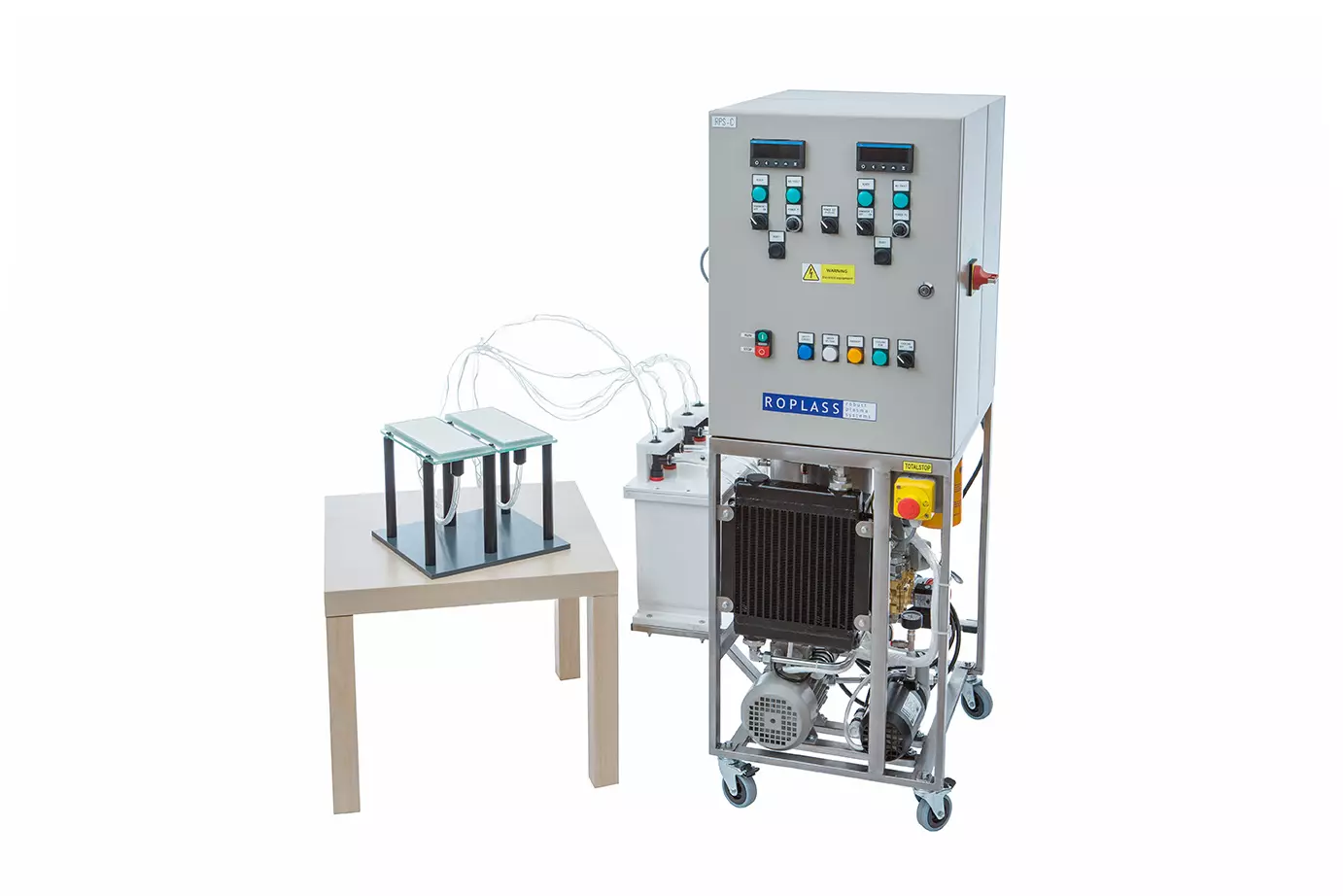
A discharge spread across the whole electrode surface, treating flat parts and flexible films uniformly. Uniformity is the deciding characteristic here : no sweeping, so no overlap and no over-treated band.
- Benchtop units — three configurations for R&D and process qualification.
- Large format — flat or curved discharge surface, power extended by adding units.
- Roll-to-roll version — for films, papers and textiles treated continuously.
Technical specifications

Precision cold plasma torch
Our cold plasma unit with a millimetre footprint, for small-area samples and sensitive substrates. Double dielectric barrier ignition sustained by radio frequency : the plasma stays cold yet dense in reactive species. It also accepts a precursor carrier gas for localised deposition.
Technical specifications

DBD plasma reactor
Our signature reactor, sized for demanding geometries and for repeatability run after run. When no catalogue configuration fits, our engineers design the reactor to specification : dimensions, gases, controllers.
- Standard configuration — small flat areas, atmospheric pressure, no pump-down cycle.
- Custom build — sized around your material, your takt time and your production environment.
Technical specifications

Your plasma partner
Design, testing and commissioning from our laboratory in Québec City.
The torch at work
The plasma leaving the nozzle, on a real part.
Parts flaking, peeling, or ink bleeding ? Send us your details : an engineer answers within 48 business hours and tells you whether a sample trial makes sense.
Get your feasibility assessmentDeposit a functional coating
Activating a surface makes it receptive ; depositing a coating gives it a property it did not have. Plasma carries a precursor to the surface and fixes it there as a nanometre-scale film, on the line, with no bath and no oven.
Understand thin-film deposition →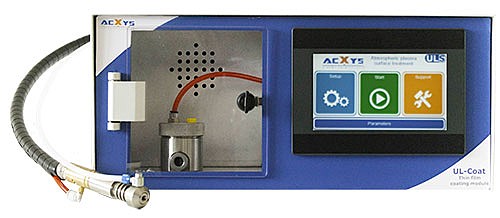
Thin-film deposition station
An atmospheric plasma deposition station that fixes a 1 to 300 nm functional film onto your parts : anti-corrosion barrier, scratch resistance, or any other property depending on the precursor selected. The choice between the two configurations depends solely on how air-reactive the precursor your application requires happens to be.
- Integrated-line configuration — the most economical, for low-reactivity precursors handled in ambient air. Compatible in particular with SiOx-type silicon precursors.
- Interchangeable-line configuration — the most versatile, for the most air-reactive precursors. The line is swapped to suit the target chemistry.
Technical specifications
Is your precursor compatible ? Describe the target chemistry and the function you need: our laboratory answers on feasibility before any paid study.
Validate my chemistryAutomate, and handle awkward formats
A manual treatment cannot be qualified : it varies from one operator to the next. These complete stations carry the source, the motion and the safety interlocks in a single machine, for a repeatable result part after part — including on formats a nozzle simply cannot handle.
Understand plasma cleaning →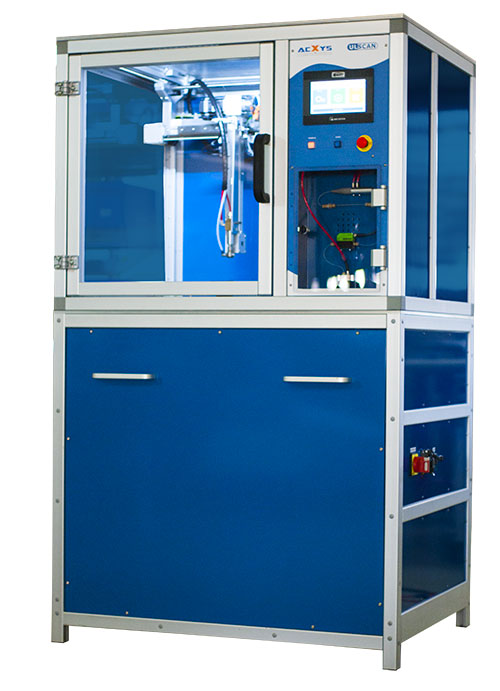
Turnkey treatment cell
An enclosed cell with a Cartesian robot, plasma source and built-in safety interlocks. You program a path, you store it, and the station replays it identically. Three equipment levels, from development bench to production cell.
- Flexible cell — 1 to 3 axis robot, with or without integrated plasma.
- Compact cell — 1 to 3 axis robot and one plasma source.
- Complete cell — robot up to 4 axes, up to three sources, gas mixer and precursor injection.
Technical specifications
Specialised treatment stations
Some materials cannot be treated like a part : a powder requires every grain to pass through the plasma. This range covers turnkey stations built for those cases, sized to specification and driven from a single interface.
- Powders and granulates — the material flows through a treatment zone, in line and without intervention.
- Surface energy raised — to improve the miscibility and solubility of powders.
- Surface energy lowered — to make the material hydrophobic and improve dispersion.
- Two further configurations — the range includes two further stations for other kinds of material. Describe your product and we will point you to the right one.
Technical specifications
Measured production result
Over [y] consecutive parts, checked with test ink on witness samples. The equivalent manual treatment gave a spread of [z] mN/m.
Is your cycle time achievable ? Send us your target takt time and the part geometry: we tell you which configuration holds it, or why none does.
Check my throughputMeasure and qualify
A treatment you do not measure is not a process, it is a bet. Measuring surface energy takes a few seconds, costs a few dollars, and tells you before you bond whether the joint will hold. It is also the hard evidence to attach to a qualification file.
Understand surface energy →
Test inks
A calibrated ink laid onto the part : if the line spreads, the surface is above the stated value ; if it beads up, it is below. Use it before printing, painting, varnishing, bonding or coating, and to check the consistency of your production on witness samples.
- Extended range — 28 to 72 mN/m, compliant with ISO 8296 : 2003, suitable for all materials.
- Non-toxic range — 22 to 72 mN/m, compliant with ASTM D2578-09, for PTFE, EPDM, PET and PVC.
- Two formats — bottle with applicator brush, or felt-tip pen.
Technical specifications
The ink test, before and after
The same ink stroke on the same part: it beads up before treatment, it spreads after. The shortest and most convincing demonstration of the process.
What the measurement settles
Before and after: documented orders of magnitude for polyolefins, not our own measurements — untreated BOPP at 26.8 mN/m, raised to 45.9 mN/m by 10 s of dielectric barrier discharge in air, 42 mN/m after just 3 s (Šrámková et al., Polymers 13, 4173, 2021); PP from 33.6 to 50.2 mN/m depending on the dose (Leroux et al., J. Colloid Interface Sci. 328, 412, 2008); PP from 36.4 to 66.5 mN/m in 1.4 s under a plasma jet (Shaw et al., Plasma Sources Sci. Technol. 25, 065018, 2016). How long the activation lasts: from a few days to a month depending on the dose and on storage — the decay is close to logarithmic and speeds up with heat (Mozetič, Polymers 15, 4668, 2023), and too short an exposure can be lost within 24 hours. It depends on the material, on how it is stored and on the downstream process — it is characterised on real parts, never from a catalogue.
Request test inks. One pen, one value, ten seconds: the cheapest way to know where your surface stands today.
Request inksChoose at a glance
The deciding criterion is almost never power, but the shape of the part and the cycle time available. This table starts there. Click a heading to sort.
| Compact torch | Localised areas on 3D parts | Spot, robot sweep | Robot arm or fixed station | Bonding, painting, marking |
| Plasma curtain | Panels, sheets, webs | 60 to 500 mm web width | In line, on the move | Large areas, high throughput |
| Surface-discharge source | Flat surfaces, flexible films | Full discharge surface | Benchtop, large format, roll-to-roll | Films, papers, textiles |
| Precision torch | Samples, sensitive substrates | ≈ 1 cm² | Test bench or robotic cell | R&D, small parts |
| DBD reactor | To specification | Sized around your part | Laboratory or line | Custom process |
| Deposition station | Parts to functionalise | 1 to 300 nm film | Dedicated station | Anti-corrosion, anti-scratch |
| Turnkey cell | Parts up to A3 format | A5 to A3, up to 300 mm/s | Standalone station | Repeatable series |
| Specialised stations | Powders, granulates and other materials | Continuous flow | In line, 3 configurations | Miscibility, dispersion |
| Test inks | Any surface | 22 à 72 mN/m | Consumable | Quality control |
Nine machines, one to choose: the decision grid
A weighted decision grid, a choice tree, a total-cost-of-ownership breakdown and the 12 questions to ask a supplier before signing. Enough to defend your choice in front of an investment committee.
Figures, not promises
Our machines are in service in the [x] sectors — and our qualification testing covers [y]. On request, we will put you in touch with a customer in your sector.
Fitting your shop floor
A machine that cannot talk to your PLC stays an island. Our sources are configured around the real constraints of your line : protocol, interface, cable length, nozzle geometry.
Power
- Three power levels depending on target throughput
- Sizing established from your own trials
Interface
- Screen version, standalone control
- OEM version, integrated into your own HMI
Communication
- RS485, RS232
- TCP-IP, Modbus TCP/IP, Modbus RTU
- PROFINET, EtherCAT (option)
- Remote control over VNC
Nozzles and cables
- Activation or texturing nozzles
- 1 to 3 cables, rigid or flexible
- Lengths of 3, 5 or 7 m
- Hand-held grip available
The machine is only part of it
Laboratory testing
Your samples are treated and characterised in our laboratory, to validate the treatment on your material before any equipment decision.
Process development
Proof of concept and process development with your teams : parameters, path, gases, throughput. The settings selected are documented.
Purchase and rental
The machine can be bought or rented, depending on whether you are industrialising or still testing a production hypothesis. The investment classes shown on each machine : [$ = x k$], [$$ = y k$], [$$$ = z k$].
Support after commissioning
Our technical team remains your direct point of contact, from commissioning through process adjustments, for as long as you run the machine.
The questions that stall a decision
The ones production managers and buyers actually ask — not the ones that suit the seller.
Do I need air extraction or ozone treatment ?
In most cases, yes. An air or nitrogen plasma at atmospheric pressure generates ozone and nitrogen oxides, which must be captured at source rather than diluted into the workshop. Our enclosed cells ship with a Ø 100 mm extraction connection ; for a source integrated on your own line, extraction is yours to plan.
Recommended extraction flow : [x] m³/h per source. We confirm this sizing with you during process development.
What is the electrode service life, and the replacement cost ?
This is the main recurring cost of any plasma machine, and the question to put to every supplier before comparing purchase prices.
On our sources : [x] hours of operation under nominal use, for a replacement cost in the region of [y] $. Replacement is carried out [z].
What gas consumption should I actually plan for ?
The flows quoted on this page are operating flows : 30 to 60 L/min for a compact torch, 60 to 500 L/min for a curtain depending on the width selected. Real consumption depends mostly on duty cycle : a station that treats for 20 seconds per part is not consuming continuously.
Many of our configurations run on compressed air, with no special gas. Nitrogen and argon are only needed for certain chemistries ; settle this early, because it drives your utilities.
Can I rent a machine before buying it ?
Yes. Our machines can be bought or rented, and rental has one precise purpose : validating a production hypothesis on your own site, with your parts and your operators, before committing to an investment.
Rental terms : [x]. Rent credited against purchase : [y].
How long from order to commissioning ?
For a standard-configuration DBD reactor, allow 1 to 3 months. For catalogue sources : [x] weeks. For an automated cell or a station built to specification : [y].
These lead times start from process validation, not from first contact. That is why we always begin by treating your samples : that step consumes no manufacturing lead time.
Does plasma damage heat-sensitive parts ?
The atmospheric plasma we use is a cold plasma : the gas stays close to ambient temperature while the reactive species are highly energetic. That is what makes it possible to treat polymers, thin films and sensitive substrates without deforming them.
The temperature rise depends on exposure time and working distance, two parameters that process development pins down precisely. On a substrate with a difficult reputation, the question is settled by a trial, not by a datasheet.
What documentation do you provide for a customer audit ?
Every machine delivered comes with the matching process file : the plasma parameters selected, characterisation methods, validation results on your parts, and operating procedures.
For regulated markets — medical, food, aerospace — the level of documentation is matched to the requirements of your sector and your customers.
What if no catalogue machine suits my part ?
That happens often, and it is where our engineering office starts rather than a refusal. The reactor is then sized around your material, your takt time and your production environment : dimensions, gases, controllers, interface.
The approach stays the same : you send us a part, we treat it, and the design starts from what actually worked in the laboratory.
Send us a part.
The fastest way to find out which machine suits your process is to let us treat your material. 48 business hours for a first answer, no commitment.
Answer within 48 business hours. No commitment. A technical conversation with an expert.